
People often treat the terms industrial and commercial refrigeration as the same thing, but they are not. They might both keep goods cold, but their use cases are very different. Choosing the wrong system could cost you money and damage to your goods. This article breaks down the differences between them so that you can make an informed choice. If you need advice contact ColdTec we have experience in all types of industrial and commercial refrigeration and cold storage throughout the UK.
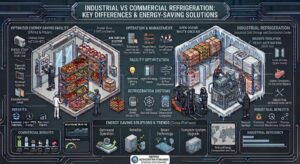
What is Commercial Refrigeration?
Commercial refrigeration consists of the units you find in shops, cafes restaurants and hotels. These would include display fridges under counter freezers and small walk in rooms that hold food and drink for sale or internal use Most units are relatively small to medium, and are used frequently by staff. They are usually designed to be accessible and easy to clean. A good commercial refrigeration service will ensure that the contents remain safe while still being displayable.
What is Industrial Refrigeration?
Industrial refrigeration is used in a food processing environment, but also in other industries such as pharmaceuticals and ice rinks. It is also used in large scale warehouses. Industrial refrigeration can consist of large chillers and freezer but also includes large temperature controlled rooms and corridors.The aim of industrial refrigeration is to cool large volumes of goods and/or large areas on a continuous basis. Industrial facilities will often have a centralised system which can consist of large compressors pipework and cooling towers.
Size and scale
One of the biggest differences is size. A commercial system might be cooling a few cabinets or a single chamber but an industrial system might be responsible for cooling an entire building with multiple rooms.You could compare it to the difference between a car and a lorry. Both are used for getting goods and people from one place to another but a car would be chosen over a lorry for a school run and a lorry would probably be chosen for daily transport.
The cooling system
he system responsible for cooling might be integrated into commercial units or placed nearby. Each chamber or room might have its own small compressor that makes these units easy to install and easy to replace.Industrial systems will consist of a centralised system using a few large compressors to cool multiple chambers or rooms with piped refrigerant. This means that industrial systems are likely to be more efficient on a large scale and will require trained engineers to keep them running.
Temperature requirements
Both commercial and industrial systems have the ability to reach chilling temperatures or freezing but there are some key differences
- Commercial chiller rooms are often between 2-8 degrees
- Commercial freezers are often -18 degrees or below
- Industrial plants may require much lower temperatures for the freezing process
- Industrial sites may require tighter temperature controls for processes
A food factory may be using a large industrial system to chill products to a specific temperature that is then maintained for storage. A commercial operation such as a shop just needs to keep goods cool until they are ready to be sold.
Power consumption and running costs
Industrial systems consume much more power, and large scale plants often have systems to make them more efficient such as smart controls or heat recovery. Commercial systems use less power in total but can add up across the site. Units that are regularly used such as commercial freezers and chiller rooms can add to the bill and issues such as dirty coils or faulty door seals can also push the cost up. Good maintenance keeps all refrigeration to a minimum.
Refrigerants and regulations
Large plants will often use a natural gas such as ammonia which requires training and special safety measures. Commercial systems tend to use fluorinated gas.UK laws cover the safe use of refrigerant gas, and more information can be found on the F-Gasguidance Qualified engineers should do any maintenance, repair or refrigerant gas handling.
Maintenance and repairs
All types of refrigeration require maintenance and a small issue can grow to major breakdown if not attended to.Commercial units are easier to repair since they tend to have modular components that can be replaced. A single visit should resolve most issues. Industrial systems are more prone to total failure of a system or component and repairs could involve bringing the whole unit down or replacing the component. This makes regular services even more important. A system that is serviced four times per year is a good choice for most facilities.
Installation
A cold room is a popular choice for commercial refrigeration, where a good cold room installationwill choose the right panels doors and cooling unit for your needs and space. Always make sure that a full written quote is given before work begins.
Which One Do You Need?
It all depends on your needs, so use this simple guide
- Choose commercial if you are a small shop cafe restaurant or food business
- Choose commercial if you need several units or a single cold room
- Choose industrial if you have a food processing or manufacturing business
- Choose industrial if you have lots of stock stored in a large warehouse
- If you have growth plans and are unsure speak to an expert
Questions to Ask a Service
- When choosing a refrigeration service ask these questions:
- Are your engineers F-Gas certified?
- Are you an approved contractor such as with [Refcom](https://www.refcom.org.uk/)
- Will I receive a full written quote?
- If the company cannot provide an answer move onto your next choice.
Why Choose ColdTec?
ColdTecas years of expertise in the refrigeration industry and can deal with almost all aspects of small, medium and large systems. We employ F-Gas qualified engineers and are a Refcom approved contractor as well as ISO 9001:2015 certified. We always use genuine parts and give a full written quote before beginning any work. Emergency maintenance services are also available should your system fail unexpectedly. Coldtec based in Surbiton covers London and the whole of the UK.
FAQs
Is industrial refrigeration just a larger version of commercial?
Not exactly, there are significant differences in both design and components. Industrial facilities often use a centralised system which will require special training for maintenance.
Can a small food business use industrial refrigeration?
In short no although it is very rare. Small businesses tend to do well with commercial units or a walk in cold room
Conclusion
Commercial refrigeration tends to be used in shops cafes and small manufacturing businesses. Industrial refrigeration is usually found in large scale facilities such as food processing plants. There are several differences between them including size cooling system temperature range regulations and cost. Make sure you choose the correct system for your needs and keep it serviced to avoid expensive downtime and high bills. If you need advice, we can help, contact ColdTec for more information.
Phone [020 3773 1250 +442037731250)
Email info@cold-tec.co.uk
Address Unit 7 177 Hook Road Surbiton KT6 5AR
Related articles; role of a commercial refrigeration engineer